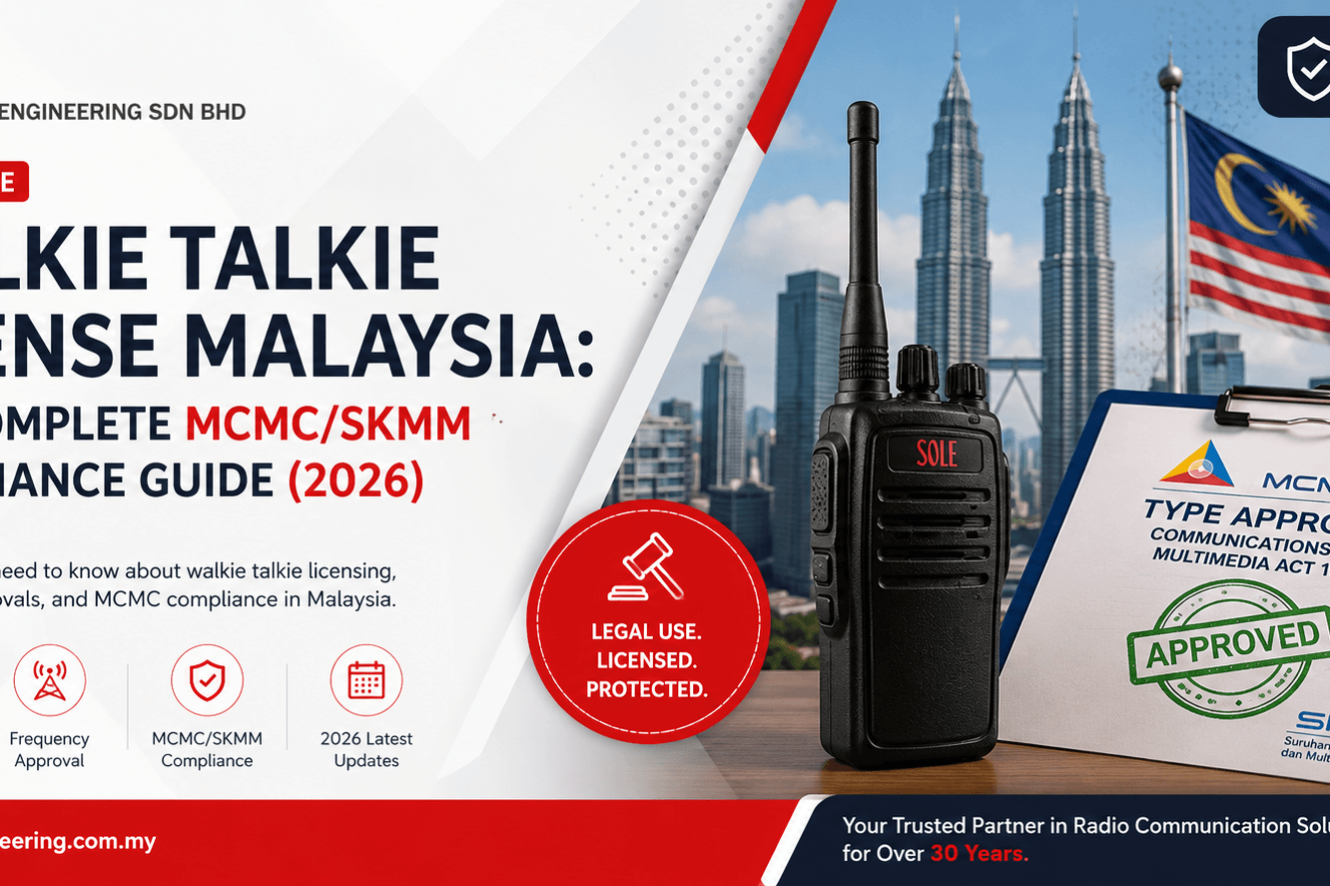
If your business is buying two-way radios for security, construction, events, or logistics, one question comes up in almost every enquiry we get at Sole Engineering: “Do I need a walkie talkie license Malaysia?” The honest answer is: it depends on the radio. Some walkie talkies can be used straight out of the box with no paperwork at all. Others legally require an Apparatus Assignment from the Malaysian Communications and Multimedia Commission (MCMC, also known as SKMM) before you switch them on.
This guide breaks down exactly when a license is required, what MCMC’s Apparatus Assignment process involves, why SIRIM certification matters, and what the consequences are for operating unlicensed radio equipment in Malaysia.
Who Regulates Walkie Talkies in Malaysia?
All radio communication equipment in Malaysia, including two-way radios and walkie talkies, falls under the jurisdiction of the Malaysian Communications and Multimedia Commission (MCMC), established in 1998. MCMC operates under the Communications and Multimedia Act 1998 (Act 588), the primary legislation governing spectrum use, radio equipment, and telecommunications in the country. MCMC manages Malaysia’s National Spectrum Plan and issues Apparatus Assignments — the formal authorization to transmit on a specific radio frequency.
Which Walkie Talkies Do NOT Need a License?
License-free PMR446 radios are the exception. These are low-power radios operating on the 446 MHz band at a maximum of 0.5 watts of transmit power. PMR446 sets are commonly sold for personal use, small retail stores, restaurants, and light commercial applications where the coverage area is small (typically a few hundred metres to a couple of kilometres, depending on terrain and obstructions).
If your radio is a genuine PMR446 unit with SIRIM type approval, you can generally use it without applying for a separate Apparatus Assignment. However, the radio itself must still carry valid SIRIM certification — more on that below.
Which Walkie Talkies DO Need an Apparatus Assignment?
Any radio that transmits above PMR446’s power limit, or operates on a frequency band assigned specifically to your business (rather than the shared license-free band), requires an Apparatus Assignment from MCMC. This typically covers:
- Professional UHF/VHF two-way radios used by security companies, construction sites, factories, and event management firms
- DMR (Digital Mobile Radio) systems with dedicated business frequencies
- TETRA radio systems used for public safety and large-scale operations
- Repeater systems that extend radio coverage across a site or building
- Any radio operating above 0.5W on a frequency not designated as license-free
What Is an Apparatus Assignment?
An Apparatus Assignment is MCMC’s formal authorization allowing a specific radio device to transmit on a specific frequency. Applications are submitted to MCMC with details of the equipment, intended frequency, and operating location. Based on publicly available guidance from MCMC’s Apparatus Assignment resources, processing generally takes a few weeks for straightforward business applications, though more complex or specialised frequency assignments can take longer. Businesses should apply well ahead of their planned deployment date — not after radios are already in use.
Why SIRIM Certification Matters
Separate from the Apparatus Assignment (which authorizes use of a frequency), every walkie talkie sold or used in Malaysia must carry valid SIRIM type approval. SIRIM QAS International certifies that the equipment meets Malaysia’s technical, safety, and electromagnetic compatibility standards. When you buy a radio, check for the SIRIM label or certification number on the unit or its documentation — this is a separate requirement from frequency licensing, and both apply.
All two-way radios supplied by Sole Engineering, including our Motorola/MOTOTRBO, Kirisun, JT189, MAGONE, and Airbus product lines, are sourced with proper Malaysian certification, which makes the compliance conversation with MCMC considerably simpler for our clients.
What Happens If You Operate an Unlicensed Radio?
The Communications and Multimedia Act 1998 gives MCMC broad enforcement powers, and the Act’s various sections set out penalties — including substantial fines and, in some cases, imprisonment — for operating radio equipment or spectrum without proper authorization. The exact penalty depends on which section of the Act applies to the specific breach. Rather than rely on a single quoted figure, the safest approach for any business is to treat licensing as a non-negotiable step before deployment and to confirm current requirements directly with MCMC or with a supplier experienced in radio compliance.
Beyond the legal risk, unlicensed or uncertified radios are also more likely to cause interference with other licensed users on the same frequency band, which can affect emergency services, aviation, and other critical communications.
A Practical Compliance Checklist for Malaysian Businesses
- Identify what type of radio you are using or planning to buy — PMR446 (license-free) or a professional business-band radio (licensed)
- Confirm the radio carries valid SIRIM certification before purchase
- If your radio requires a business frequency, apply for an Apparatus Assignment with MCMC before deployment
- Keep your Apparatus Assignment documentation on file for audits
- Work with an established, licensed two-way radio supplier who can advise on the correct equipment and frequency for your use case
How Sole Engineering Can Help
Sole Engineering Sdn. Bhd. has been supplying and servicing two-way radio communication equipment in Malaysia since 1985. We supply SIRIM-certified analog and DMR walkie talkies, PTT-over-cellular radios, ATEX-rated handphones for hazardous environments, and TETRA radio and repeater systems from brands including Motorola/MOTOTRBO, Kirisun, JT189, MAGONE, and Airbus. Our team can advise on which radios suit your operation and support you through the practical side of frequency and equipment compliance, along with warranty repair, programming, and rental services for short- or long-term needs.
Frequently Asked Questions
Do I need a walkie talkie license Malaysia?
It depends on the radio. License-free PMR446 radios (446 MHz, max 0.5 watts) generally do not require a separate Apparatus Assignment, but they must still carry SIRIM certification. Higher-power professional radios or those on dedicated business frequencies require an Apparatus Assignment from MCMC before use.
What is PMR446?
PMR446 refers to a license-free radio band at 446 MHz with a maximum transmit power of 0.5 watts, commonly used for personal or light commercial two-way radio communication in Malaysia and many other countries.
What is an MCMC Apparatus Assignment?
An Apparatus Assignment is the formal authorization issued by MCMC that permits a specific radio device to transmit on a specific frequency. It is required for professional or business-band radios that fall outside the license-free PMR446 category.
Is SIRIM certification the same as an MCMC license?
No. SIRIM certification confirms the radio equipment itself meets Malaysia’s technical and safety standards. An MCMC Apparatus Assignment separately authorizes the use of a specific frequency. Both requirements can apply to the same radio.
What happens if I use an unlicensed radio in Malaysia?
Operating radio equipment without the required MCMC authorization is an offence under the Communications and Multimedia Act 1998, which provides for fines and imprisonment depending on the specific breach. Businesses should confirm current requirements with MCMC before deploying radios.
Conclusion
Radio licensing in Malaysia isn’t complicated once you know which category your equipment falls into — but getting it wrong can mean fines, confiscated equipment, or interference with other licensed users. If you’re unsure whether your walkie talkies need an Apparatus Assignment, talk to a supplier who deals with MCMC compliance daily. Sole Engineering has supported Malaysian businesses with certified two-way radio equipment since 1985 and can help you choose and set up the right, compliant solution for your site.
.