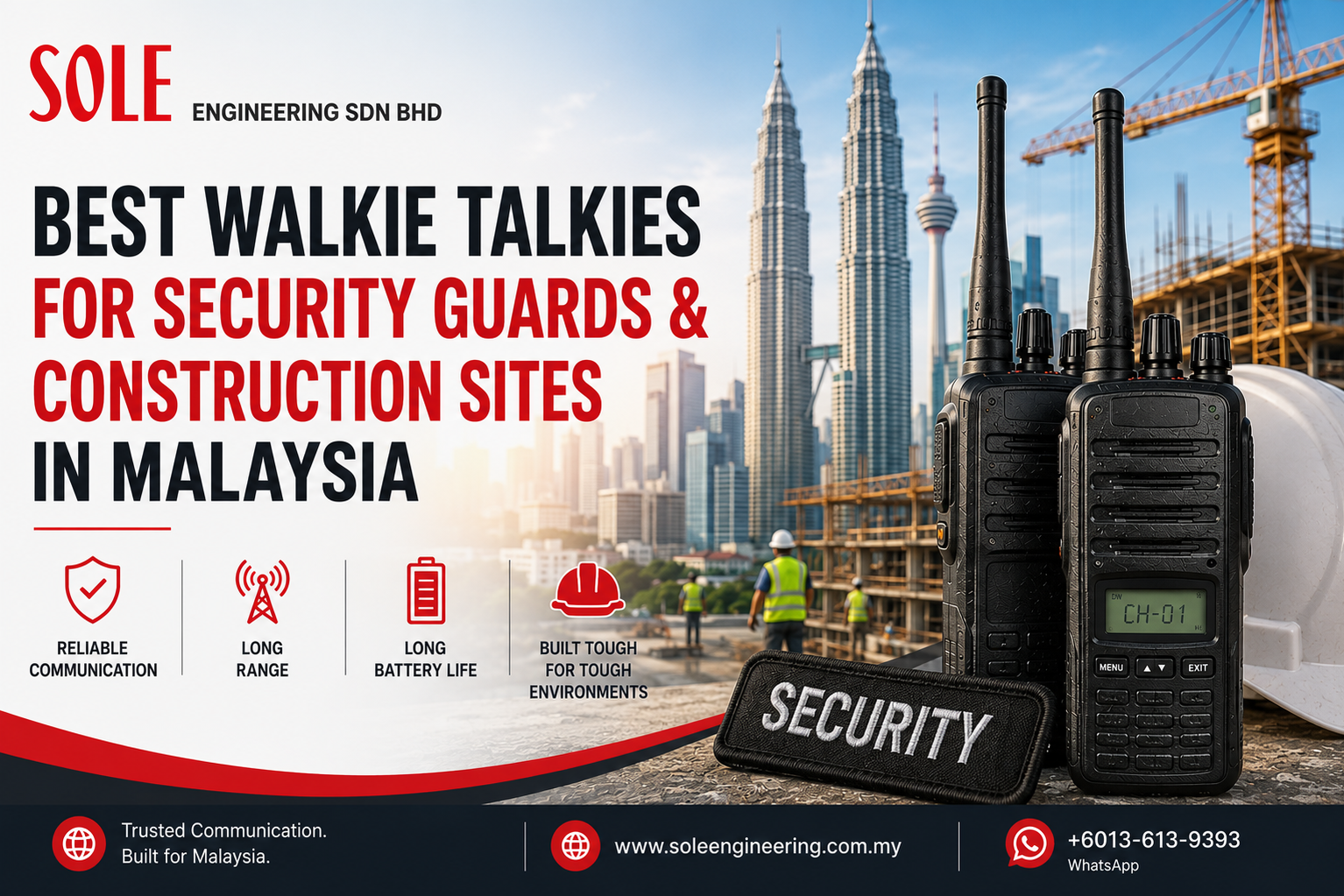
Security and construction teams put radios through more punishment than almost any other user group — dust, rain, drops, long shifts, and sites that can stretch across several buildings or floors. Picking the wrong radio means dropped signal in stairwells, batteries that die mid-shift, or a device that can’t survive being knocked off a scaffold. This guide walks through what actually matters when choosing walkie talkies for security guards or construction work in Malaysia, and which radio category fits which type of site.
What Security & Construction Teams Actually Need From a Radio
- Durability — a rugged housing that survives drops, dust, and Malaysia’s rain and humidity
- Battery life that comfortably covers a full shift (8–12 hours), with fast-charging or hot-swappable batteries for round-the-clock operations
- Reliable coverage across the whole site, including basements, stairwells, and multi-storey structures
- Clear audio in noisy environments — machinery, traffic, crowds
- Enough channels and, for larger teams, group-calling or private-call functions to separate departments (e.g. security vs. site management)
Radio Types Compared
Analog Walkie Talkie Radios
Analog radios remain a solid, affordable option for smaller security teams or single-site construction jobs where budget matters more than advanced features. They’re simple to operate, require less programming, and are a reasonable entry point for teams of 5–20 people o n a contained site.
DMR (Digital Mobile Radio)
For larger or more complex sites, DMR is generally the better choice. Digital transmission gives clearer audio at the edge of coverage (where analog radios start to hiss and crackle, DMR tends to stay clear or cut out cleanly), longer battery life for the same transmit power, and the ability to run two talk paths on a single frequency — useful for separating security channels from site-operations channels. DMR also supports encryption on many models, which matters for sites handling sensitive information or high-value assets.
PTT Over Cellular (PoC)
Push-to-Talk over Cellular radios use the mobile data network instead of a dedicated radio frequency, giving effectively unlimited range — useful for security operations that span multiple sites across a city or state, since coverage isn’t limited by line-of-sight or repeater placement. The trade-off is dependency on cellular signal, so PoC works best as a complement to, rather than a full replacement for, on-site DMR or analog radios in areas with patchy mobile coverage.
TETRA Radio & Repeater Systems
For large-scale construction developments, industrial sites, or operations needing mission-critical reliability, TETRA offers high-performance, secure trunked communication with excellent group-call management — the same technology standard used in public safety communications.
ATEX-Rated Handphones
Construction and industrial sites with flammable materials, fuel storage, or explosive atmospheres (oil & gas, chemical plants) require ATEX-certified radios specifically designed to prevent sparking in hazardous zones. Standard commercial radios should never be used in these environments.
Buy or Rent Walkie Talkies For Security Guards
For permanent security operations or ongoing construction work, purchasing radios usually makes more financial sense over time and allows for custom programming specific to your site. For short-term projects, one-off events, or trialling a new radio system before committing, rental is worth considering — Sole Engineering offers both short-term and long-term rental of two-way radio equipment, alongside outright purchase.
Choosing a Supplier You Can Rely On
Beyond the radio itself, look for a supplier who can service, repair, and reprogram your fleet locally — downtime on a security or construction radio system isn’t just inconvenient, it’s a safety issue. Sole Engineering Sdn. Bhd., based in Shah Alam, Selangor, has supplied and serviced two-way radios in Malaysia since 1985, with warranty and non-warranty repair, on-site configuration and programming, spare parts support, and user training for brands including Motorola/MOTOTRBO, Kirisun, JT189, MAGONE, and Airbus.
Frequently Asked Questions
What type of radio is best for a construction site in Malaysia?
For most mid-to-large construction sites, DMR (Digital Mobile Radio) offers the best balance of coverage, audio clarity, and battery life. Smaller sites on a tighter budget can use analog radios, while sites handling flammable materials require ATEX-certified radios.
Do security guards need digital (DMR) radios instead of analog?
Not always — it depends on team size and site complexity. Smaller teams on a single, contained site can manage well with analog radios. Larger security operations, multi-building sites, or teams needing separate channels for different functions generally benefit from DMR.
Is it better to buy or rent walkie talkies for a construction project?
For long-term or permanent operations, buying is usually more cost-effective and allows custom programming. For short-term projects or events, renting avoids the upfront cost and lets you scale the number of units up or down as needed.
Can regular walkie talkies be used near flammable materials or fuel?
No. Sites with flammable materials or explosive atmospheres require ATEX-certified radios designed to prevent sparking. Standard commercial radios are not rated for these environments.
Conclusion
The right walkie talkie for a security or construction team depends on site size, budget, and how critical reliable communication is to safety. Analog works for small, simple sites; DMR suits most mid-to-large professional operations; PTT-over-cellular extends reach across multiple locations; and TETRA or ATEX-rated equipment covers the most demanding or hazardous environments. Sole Engineering can help assess your site and recommend the right mix of equipment, whether you’re buying, renting, or upgrading an existing radio fleet.