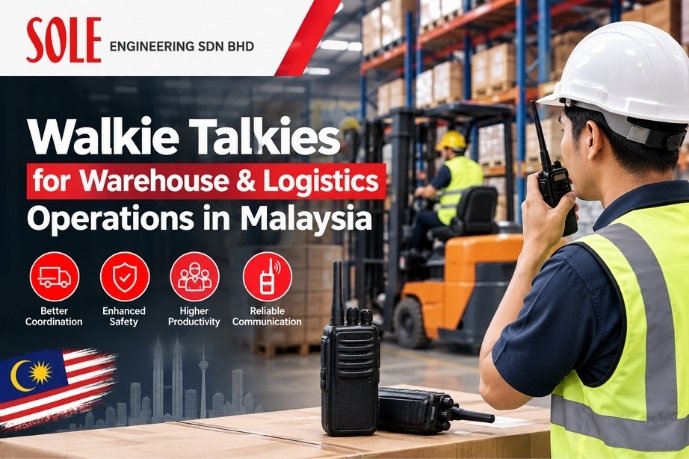
Warehouses and distribution centres run on split-second coordination. A picker who can’t reach the forklift driver, or a supervisor who can’t flag a safety issue instantly, costs real money, and in cold storage or high-racking environments, it can cost a lot more than money. This guide covers how to choose and deploy walkie talkies for warehouse and logistics operations in Malaysia.
Why Phones Don’t Cut It on the Warehouse Floor
Mobile phones seem convenient, but in a working warehouse they fall short in ways that matter:
- Dead zones: Steel racking, concrete, and metal roofing block or weaken cellular signal in large facilities and basements.
- One-to-one only: A phone call reaches one person. A radio call reaches the whole team — or the exact group that needs to hear it — instantly.
- Slower in emergencies: Dialling, waiting for pickup, and talking takes far longer than pressing a push-to-talk button.
- Not built for gloves, dust, or drops: Consumer phones aren’t rated for the daily abuse of a logistics floor.
What to Look For in a Warehouse Radio System
- Coverage across the full facility Large warehouses, multi-level racking, and cold rooms need radios with strong in-building penetration. UHF radios generally outperform VHF indoors because UHF wavelengths handle obstructions like shelving and machinery better.
- Digital (DMR) over analog DMR radios give clearer audio at the edge of range, longer battery life (thanks to more efficient TDMA transmission), and built-in features like individual/group calling — useful for routing a message to just the loading bay team instead of the whole warehouse.
- Durability rating Look for an IP54 or higher ingress rating and MIL-STD-810G shock resistance. Warehouse radios get dropped from forklifts, mezzanines, and racking ladders.
- Battery life for full shifts A single shift on a logistics floor can run 10–12 hours. Choose radios with a battery rated for a full shift plus buffer, and consider a multi-unit charging bank for fast turnaround between shifts.
- Cold storage performance If your operation includes chilled or frozen storage, confirm the radio’s rated operating temperature — many consumer-grade radios lose battery performance quickly below 0°C.
- Repeater compatibility For multi-building sites or facilities with basements, a repeater system extends coverage without needing everyone to carry a high-power radio.
Recommended Radio Types by Role
- Pickers & packers: Compact UHF handheld with a hands-free earpiece for speed.
- Forklift operators: Radio with a remote speaker mic or vehicle-mounted unit so hands stay on the wheel.
- Dock & receiving staff: Radios with a loud, clear speaker to cut through loading-bay noise.
- Supervisors: Radios with multi-channel/group-call capability to manage several zones at once.
- Security & gatehouse: Long-range radios, ideally linked into the same repeater system as the main floor.
Channel Planning for a Logistics Operation
A common and effective setup:
- Channel 1 — General floor operations (picking, packing, general coordination)
- Channel 2 — Loading/unloading & dock
- Channel 3 — Maintenance/facilities
- Channel 4 — Emergency/priority (kept clear for incidents only)
Digital radios also allow private group calling, so departments can talk without cluttering a shared channel — a major advantage over analog for larger sites.
Compliance Note for Malaysia
Two-way radios operating above the licence-exempt power threshold require an MCMC licence and MCMC-approved equipment. See our guide on walkie talkie licensing in Malaysia before deploying a fleet, and confirm your supplier provides MCMC-approved units.
Getting Started
Sole Engineering supplies, rents, and services two-way radio systems for warehouses and logistics operators across Malaysia, including site surveys to confirm coverage before you commit to a fleet. Contact us for a warehouse communication assessment.
FAQs
Q: What type of walkie talkie is best for a warehouse?
A: UHF digital (DMR) radios are best for most warehouses because UHF signals penetrate racking, concrete, and machinery better than VHF, and DMR provides clearer audio and longer battery life than analog radios.
Q: How many walkie talkies does a warehouse need?
A: As a starting point, plan for one radio per active role per shift — pickers, dock staff, forklift operators, and supervisors — plus 10–15% spares for charging rotation and backup.
Q: Do walkie talkies for warehouse need an MCMC licence in Malaysia?
A: Yes, radios operating above the licence-exempt power output require MCMC licensing and MCMC-approved equipment. Confirm licensing requirements before large-scale deployment.
Q: Can walkie talkies work in cold storage warehouses?
A: Yes, but not all radios are rated for sub-zero use. Choose units with a confirmed low-temperature operating range, as standard battery packs lose capacity quickly in cold storage.
Q: How do I extend radio coverage in a large or multi-level warehouse?
A: Install a repeater system. A single repeater can extend usable radio range across an entire large facility, including basements and upper mezzanine levels, without upgrading every handheld.