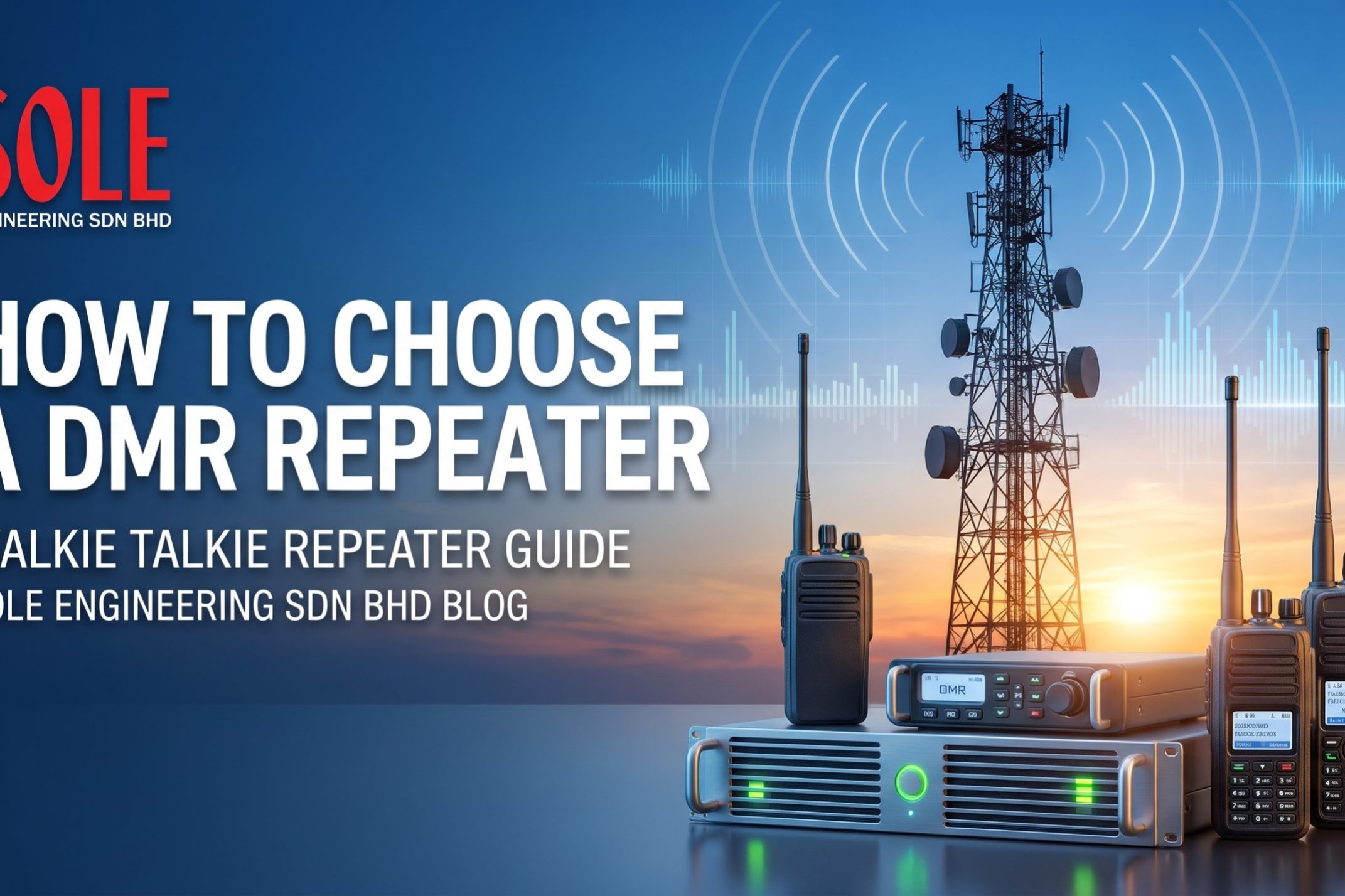
A walkie talkie repeater receives a radio’s signal and retransmits it, usually from a high point, so handheld radios reach much further and through more obstacles. You need one when radios cannot reach each other across large sites, tall buildings or varied terrain. When choosing a DMR repeater, check its power and duty rating, analog and digital support, monitoring tools, site-linking options, and the antenna and cable it will work with.
How a walkie talkie repeater works
Two radios talking directly depend on their own small antennas and low power. A repeater is a fixed station with a better antenna, placed high. It receives your transmission on one frequency and retransmits it on another at the same time, so every radio in range of the repeater can hear it, even when two radios cannot hear each other directly.
Because the repeater sends and receives on different frequencies, your radios must be set up for repeater use and programmed with the right pair. Our guide to how to program a walkie-talkie covers the basics.
Signs you need a repeater
- Radios drop out between buildings, floors or basements
- Your site spans a large compound, a campus or several blocks
- Terrain, such as hills or dense structures, blocks the signal
- Teams at the edge of the site cannot reach the control room
- You have already tried better antennas and more power, with limited results
Read our guides on how to increase walkie-talkie range and DMR radio range before deciding.
Repeater or something else?
| Option | Best when | Limitation |
| Repeater | You want local, always-on coverage across one site | Needs installation, an antenna and approvals |
| Linked repeaters across sites | You need coverage at several locations | Needs network links and planning |
| Push-to-talk over cellular | Teams are spread over wide areas with mobile network coverage | Depends on the cellular network |
| Better handheld or accessory | A small range gap exists | Cannot fix a large coverage problem |
What to check when choosing a DMR repeater
Sole Engineering lists two DMR repeaters on its DMR walkie talkie page. Use them as a model for the questions to ask any supplier.
| Question | Why it matters | Example from Sole’s range |
| Can it run continuously at full power? | Busy sites transmit often | The Motorola SLR5300 is designed for round-the-clock operation, even at a continuous full transmit power of 50W, and was validated through Motorola’s Accelerated Life Testing program |
| Does it handle analog and digital? | Mixed fleets need both | The DR600 lists smart digital-analog auto detection |
| Can you monitor it remotely? | Faster fault-finding | The DR600 lists remote monitoring and diagnosis, plus an LED indicator |
| Will it fit your rack and stay cool? | Heat shortens equipment life | The DR600 lists a professional 1U design and outstanding heat dissipation |
| Can it connect to other systems or sites? | Needed for growth | The DR600 lists an AIS/SIP interface, accessory expansion and an optional IP Site Link connection |
If you also run Motorola MOTOTRBO handhelds, note that Sole lists IP Site Connect on the MOTOTRBO C2620. Ask your supplier how your radios and repeater will work together.
Do not forget the antenna and cable
The repeater is only half the system. Coverage depends heavily on the antenna, its height and the cable that connects it. A lossy cable wastes the signal before it ever leaves the building, so low-loss coaxial cable matters. Sole Engineering supplies TIMES Microwave cables and connectors; see our guides on LMR-400 cable, LMR-240 cable and choosing a walkie-talkie antenna.
Licensing and site survey
A walkie talkie repeater transmits on assigned frequencies, so you should confirm the approvals and frequency assignment you need before installing. Read our walkie-talkie licence guide and check current requirements with MCMC. A site survey of your building layout, construction and terrain will show where the antenna should go and what coverage to expect.
Steps to deploy a repeater system
- Survey the site and define the coverage you need.
- Choose the walkie talkie repeater, antenna, cable and any linking requirements.
- Confirm frequency and approval requirements.
- Install the repeater and antenna.
- Programme your radios for repeater operation.
- Walk-test coverage in the areas that matter most.
- Plan servicing and monitoring for the long term.
Frequently asked questions
What does a walkie-talkie repeater do?
A repeater receives a radio signal and retransmits it, usually from a high location, so handheld radios can communicate over a much wider area or through more obstacles.
Do I need a repeater for my walkie-talkies?
You need one if radios cannot reach each other across your site because of distance, buildings or terrain, and better antennas or accessories have not solved it.
Can any walkie-talkie work with a repeater?
Not every radio does. The two way radio must be able to transmit and receive on different frequencies and be programmed for repeater use.
Does Sole Engineering supply DMR repeaters?
Yes. Sole Engineering’s DMR range lists the Motorola SLR5300 and the DR600 DMR repeater, and it also offers a TETRA radio and repeater system.
Plan your repeater system with Sole Engineering
Tell us about your site and radios. Email sole@soleengineering.com.my or call 03-5125 9669 or 03-5125 9701, and see our TETRA radio guide if you need a TETRA network.